Cuba. This time, I’ll be your guide through this noble and truly symbolic part of the cigar world. And the spotlight is on a rather intriguing Habanos release – La Flor de Cano Elegidos.
This is the third budget-friendly Habanos cigar we’ve reviewed here. So how did it perform? Is it worth your attention? Does it carry the same charm as the others we’ve smoked before? We’ll try to answer all those questions in today’s review. Let’s dive in!
La Flor de Cano
This brand has always been a bit of an oddball. Always around, never quite in the spotlight. Think of it as that Cuban aunt from the countryside who shows up at a wedding once a year and steals the show. Officially, the brand was registered by brothers José and Tomás Cano back in 1884 – long before the world even dreamed of cigar Instagram. The brothers also produced cigars under the name La Leonora, about which we know about as much as we do about the love lives of Clubmaster smokers – which is to say, not much.
For decades, La Flor de Cano stayed in family hands until Cuba switched off the lights of the free market and the tobacco industry became a collective affair. And here’s the twist: despite never being a major player, the brand gained real recognition abroad – especially in Spain and the UK. For some reason, the Brits found it worth a spot in their humidors, maybe because it struck that fine balance between “not too strong” and “not too dull.” That popularity saved it from extinction when Habanos S.A. streamlined its portfolio in the early 2000s, cutting formats that sold about as well as label-less wine.
Only two vitolas survived, both simplified to the max. Some earlier ones were hand-rolled, others machine-made. Today, thankfully, the surviving sticks are fully handmade – though from short filler (tripa corta). Basically, think of it as high-quality meatloaf: made of cuttings, but still tasty and affordable.
And here’s a fun detail for collectors and limited-edition hunters: every now and then, La Flor de Cano pops up in regional editions. And that’s when it puts on a tux and shows up at the opera. These special releases use long filler (tripa larga) from the legendary Vuelta Abajo – crème de la crème of Cuban terroir. Which means you never quite know if this “budget brand” is about to surprise you with a gem in disguise.
La Flor de Cano Elegidos
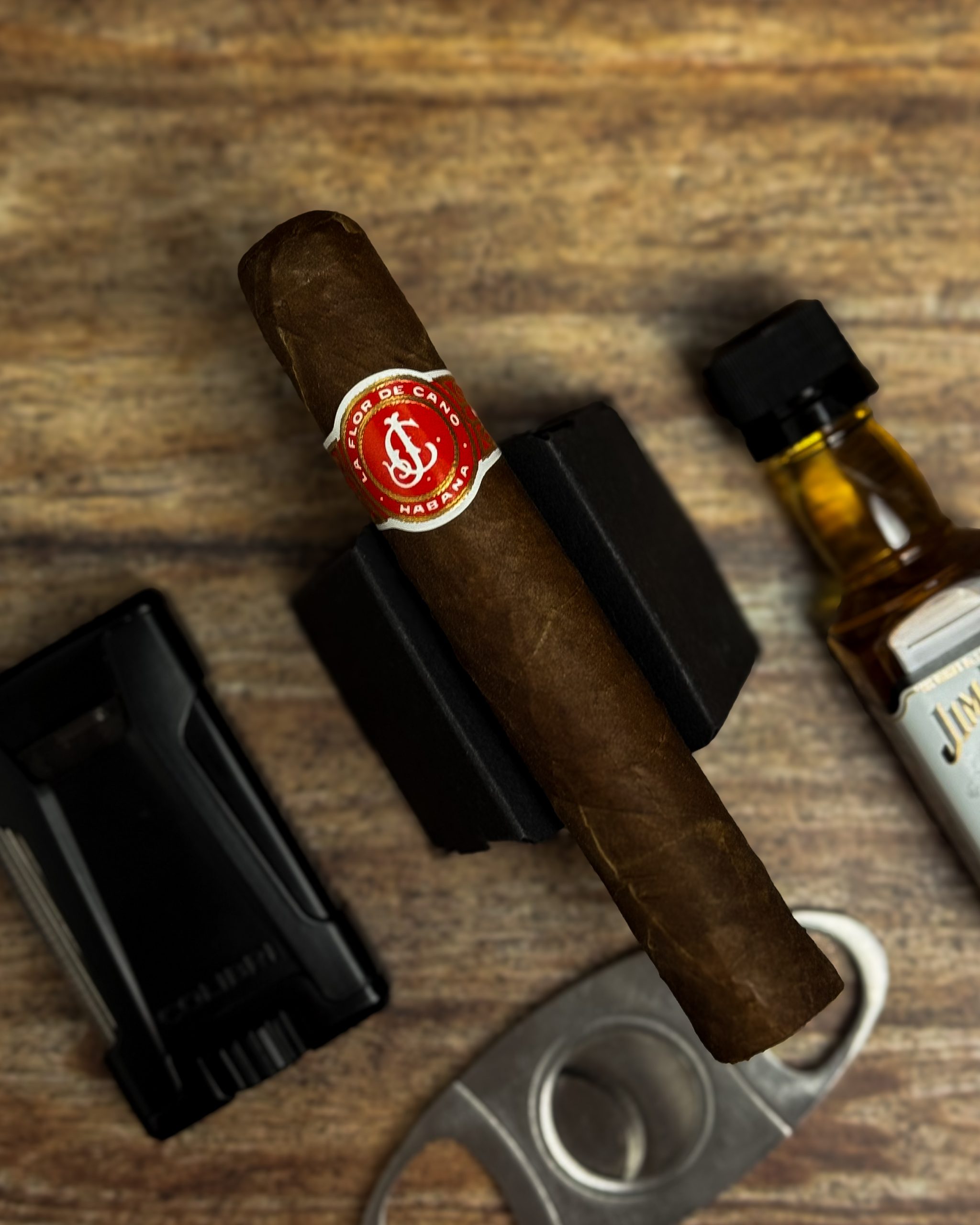
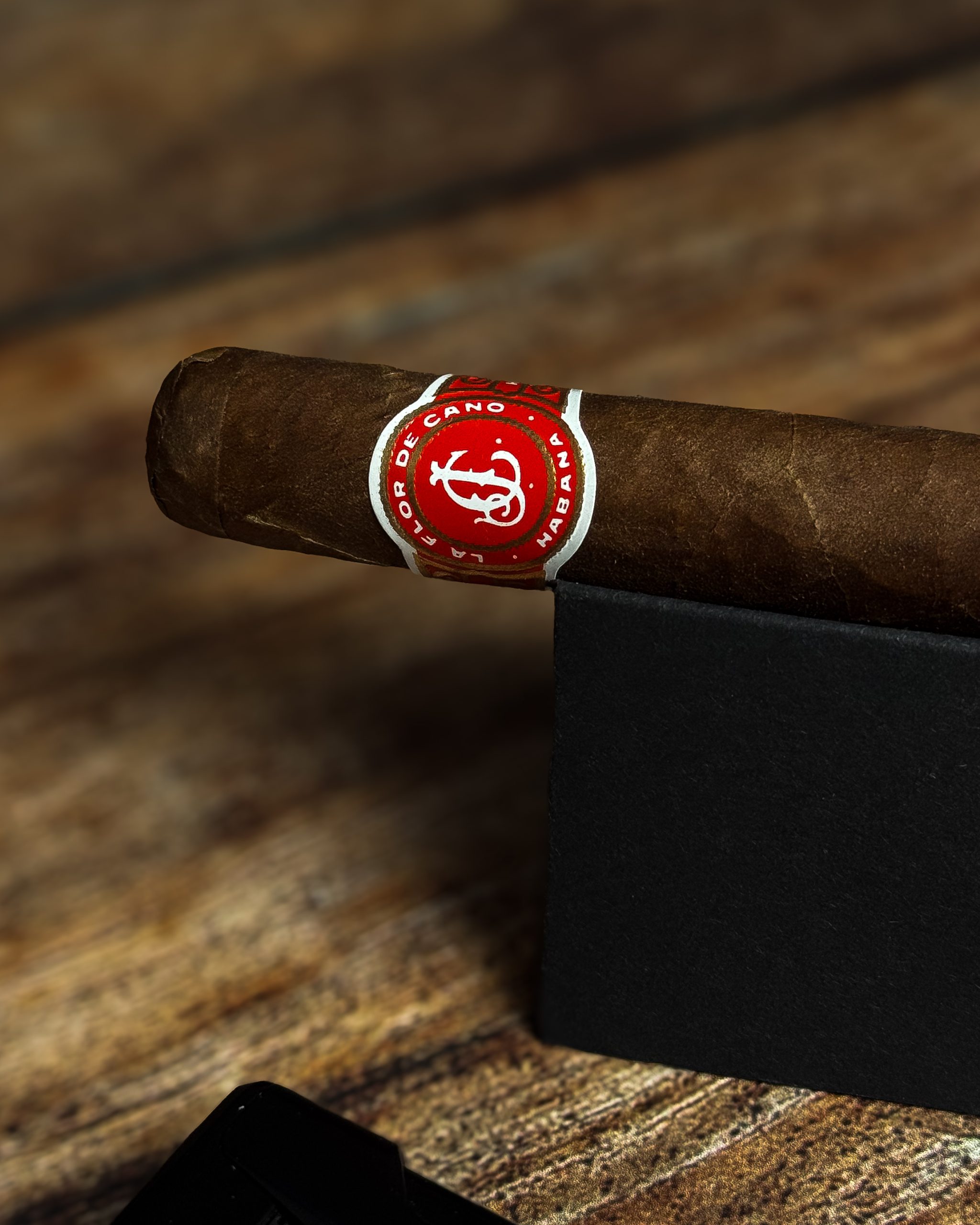
The vitola we’re looking at today is the Elegidos. Outside of Habanos’ fancy naming, this is a classic robusto – down to the very inch. Important note: we’re dealing with a short filler here, though fully handmade (totalmente a mano). Which means I wasn’t expecting flawless construction or ash that clings like Tom Cruise to a cliff in Mission Impossible 2.
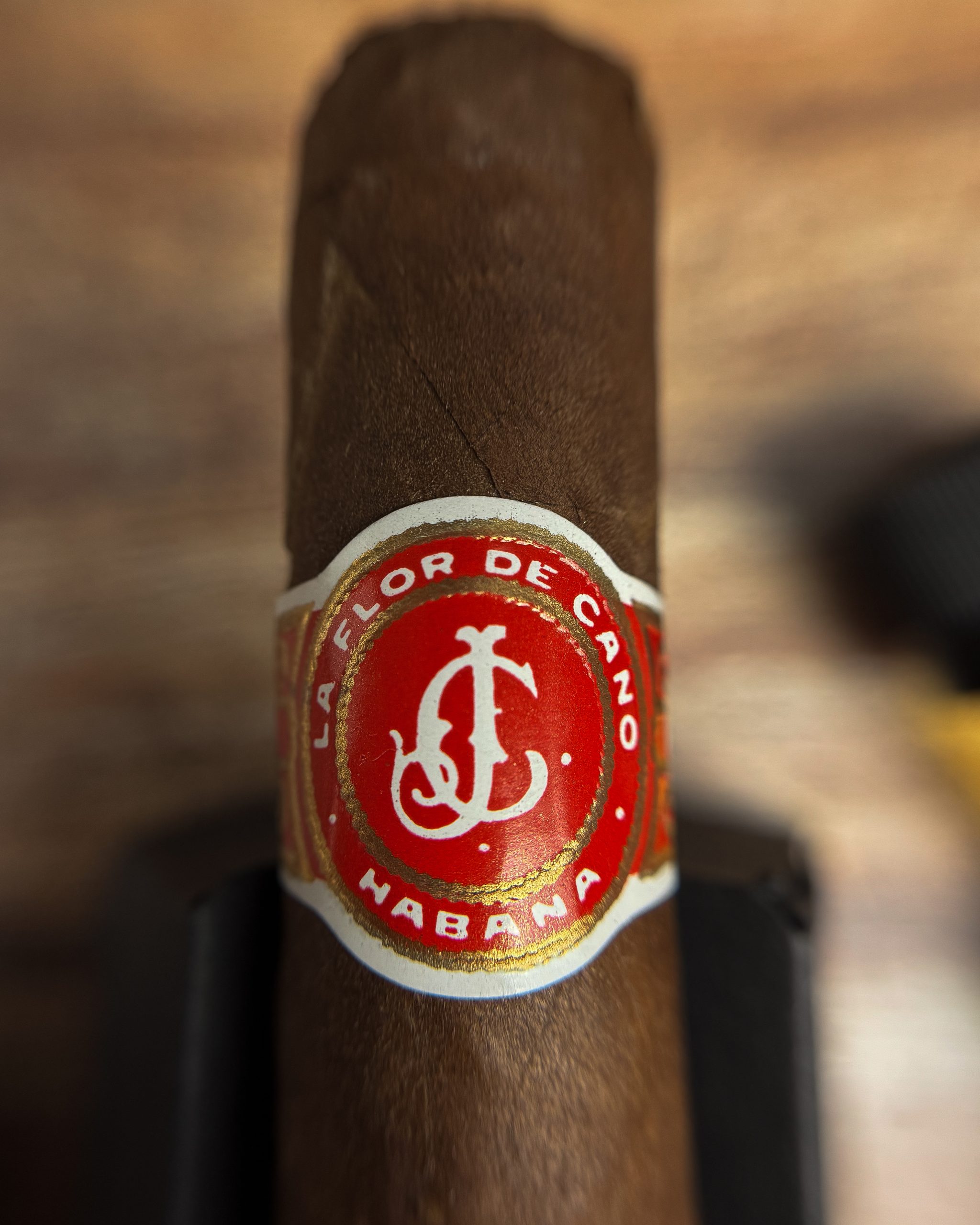
Let’s pause for a moment on the band. Even though this cigar sits in the budget category, the presentation is spot on. A deep, classic red, framed with subtle white, finished with elegant lettering. Everything just works. There’s a sense of refinement and cohesion in the design. Compared to many other budget Habanos bands, this one really stands out. Maybe it’s the color, maybe the composition, but honestly – it’s one of the most attractive standard-line Habanos bands I’ve come across. And not just for its price bracket.
As for the tobacco: the blend pulls from two Cuban regions – Vuelta Abajo and Semi Vuelta. Allegedly, this is where the old-school Cuban aromas truly come alive. That promises a mix leaning toward classic notes: wood, coffee, a touch of leather (not exactly my dream trio, but let’s see), and occasionally a pinch of spice. Some even say you can pick up a faint sweetness weaving its way between the puffs. Basically, the setup here is old Cuban melodies hummed under the breath.
Vitolas currently in the La Flor de Cano line:
- Petit Coronas (40 × 4 7/8)
- Elegidos (50 × 5)
- Mágicos (52 × 4 1/2) – regional release, long filler
- Robustos (50 × 4 7/8) – regional release, long filler
Now, let’s light up and see where this takes us.
Lights, cut, action
As tradition demands, the cigar has to be tested “cold” first. On the nose – classic Cuba: cedar and buckwheat honey. I’ve grown used to picking up honeyed, floral notes in Cuban sticks; maybe that’s just how my senses are wired. There was also a little tickle in the nose, the telltale sign of spice – pepper included.
I went with a straight cut – nothing fancy. And here came the first surprise: tasting the wrapper brought out this odd tang, almost citrusy. Coffee sommeliers would probably call it fruity acidity. To me, it was just… sour. The draw turned out fairly tight. Not a total plug, but not exactly effortless either. Still, that resistance almost felt like a stamp of authenticity – yep, definitely a Cuban. Time to put fire to it.
The Thirds
First puff. The cigar opened gently. Too gently. It’s supposed to be medium-bodied, so I was hoping it would kick in eventually. The draw, thankfully, turned out better than expected. And the aroma of the smoke? Gorgeous – sweet and creamy. I wanted those notes to show up in the flavor too, but that would take some patience. The wrapper was still tangy, and it started to bother me. Luckily, about twenty minutes in – right at the close of the first third – honey showed up.
And just as quickly, the honey was gone. That tangy, almost fruity wrapper note kept sneaking in, and it wasn’t doing me any favors. Every now and then, I could catch a flash of coffee in the profile, but mostly it was the wrapper calling the shots. I had to fight back. A couple of kabanos sticks (thin sausages) and some chocolate later, my palate was reset, and that sour edge was neutralized. Even the hints of wood disappeared (thankfully). Half an hour down, the cigar was still light-bodied. If flavors came, they flickered or fell flat. The only real joy at that stage was the smoke itself. And then…
Final third. Now the strength picked up. Flavors rolled in. Steam engine in motion: honey, coffee, sweetness – all vivid, all intense. Finally, that unmistakable Cuban character showed up. And as in life: it’s not about how you start, but how you finish. The pace slowed naturally – I wanted to savor every puff. Even the draw became spot-on at this stage.
I haven’t mentioned the ash yet. I came in expecting to babysit the ashtray, chin practically over it – short filler, after all, so I figured it would crumble. But no. The ash held tight, compact and elegant, clinging on like Tom Cruise in Mission Impossible. Turns out, not so impossible after all.
Final thoughts on La Flor de Cano Elegidos
98 minutes. That’s how long it took from the first spark to the final rest in the ashtray. I finished with a smile on my face, though I couldn’t decide what amused me more: the emergency rations of kabanos and chocolate, or the fact that it took until the final third for the cigar to actually deliver. Shame it came so late.
In my view, the La Flor de Cano Elegidos ended up the weakest of the Cuban “budget trio.” Despite its interesting backstory and by far the best-looking band – one that never hints you’re smoking a short filler – it just didn’t work out. If only you could cut out the first two thirds and light up just the last one. But cigars don’t work that way.
In my subjective opinion (and that’s what these reviews are, after all), this cigar felt totalmente budgetos. Yes, the leaves come from Cuba’s top growing regions, but you can taste the cuts – not just in leaf size, but in the whole process.
I don’t doubt there are smokers who’ll enjoy this profile. If the cigar’s still on the market, it means someone’s buying it and finding pleasure. That person just won’t be me.
And yet… there’s this one thought lingering in the back of my mind, tied closely to Cuba itself: what if this cigar just needs more time? What if it rests? With that thought, I leave both myself and you, dear reader.
This cigar was kindly provided by Premium Cigars, thanks to Szymon Kwiatkowski.
Note from Mateusz Krzywiecki
Mateusz writes here.
Piotr left me this little placeholder: “Mateusz writes here.” Good thing I only had to describe my impressions, because honestly, I wouldn’t know how to craft a proper review of this cigar on my own. I did take some notes, but…
The wrapper was ugly, veiny – probably the worst-looking of the budget Cuban trio we recently reviewed. The aroma, though, told a different story: sweet and pleasant. Like Piotr, I cut it with a straight cutter. The draw… well, tight. In terms of flavor, there was some wood and a hint of sweetness, though I wouldn’t exactly call it honey.
Once lit, the cigar gave me notes of coffee and wood. There was also roasted almond, though more burnt than roasted, which left a bitter edge. Honestly, until the final third, there wasn’t much to write about. Only then did the cigar finally decide to offer me something more than bitter air. The draw improved too – though maybe that was because I picked out some pieces of tobacco from the head. At that point, I started picking up sharp wood and leather, along with a touch of dark chocolate.
On the aroma side, I found pepper and dark chocolate. But you really had to dig for them, because the cigar produced very little smoke. It burned evenly, yes, but smoking it was a chore, not a pleasure. Only when the draw finally improved did the cigar start producing more smoke and delivering stronger flavors. By then, though, I was already annoyed by the little bits of tobacco I had to spit out every now and then.
The worst of the three we reviewed. Quintero – and then better nothing.
If you enjoyed reading this, let me know! Drop a comment or share the post – every bit of support helps others discover my cigar reviews and smoking tips. If you prefer to listen, I co-host a podcast with Piotr Siwiński called „Spotkanie z Dymem” („A Meeting with Smoke”) – currently in Polish, though who knows what the future holds? You can also find me on Instagram, where I share a slice of my cigar life – and a bit more. I always welcome a good conversation. That’s how great connections start – and they often go far beyond just cigars.
Stay smoky!
Piotr Siwiński, @mycigarway, Mateusz Krzywiecki, @mateusz.krzywiecki, Polski Aficionado, @polskiaficionado